BrewChat
Improving the Networking Experience from First Connection to a Lasting Relationship
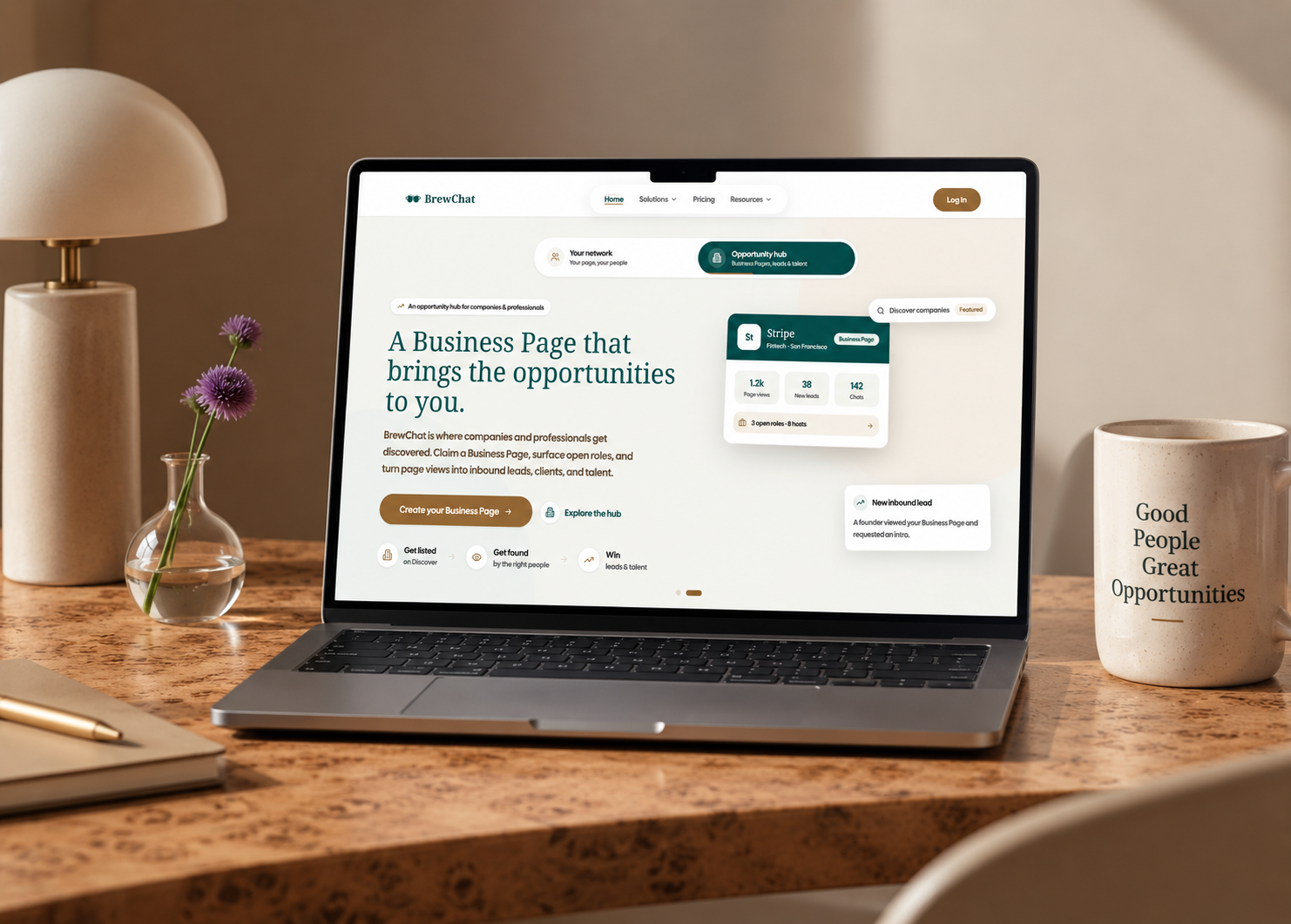
For a Reach Consulting Club project, my team partnered with BrewChat, a professional networking platform built around low-pressure coffee chats. We conducted user and market research to uncover friction throughout the networking journey and developed product recommendations designed to make connections more relevant, trustworthy, and lasting.
The Problem: We noticed that students rely heavily on cold emails and LinkedIn messages to connect with professionals, but unanswered outreach, scheduling friction, and uncertainty around who is actually willing to help make the process frustrating.
Our Challenge: How might BrewChat create a more reliable and meaningful path from finding a professional to building a lasting connection?
Role: Project Manager | Team: 4 Students | Timeline: Winter 2026
Our Process
Market + Competitor Research
DISCOVER
User Interviews + Surveys
UNDERSTAND
BrewChat Workflow Testing
TEST
Insights + Recommendations
DESIGN
We used a mixed-method research approach to understand both how people currently network and how they interacted with BrewChat's existing experience.
The report specifically combined market research, user-flow analysis, qualitative interviews/observations, and quantitative survey research.
INITIAL MARKET RESEARCH
-
Users discover professionals → initiate outreach → attempt to schedule a conversation → have the call → gain value from the interaction.
-
Unreliability in outreach - high rates of ghosting and no replies from professionals
Unclear outcomes - users are unsure what value they'll get from a conversation before committing time
Difficulty in scheduling - coordination friction when trying to find a mutual time
Time uncertainty - unclear how long interactions will take, creating hesitation
Lack of incentives for professionals - nothing motivates professionals to respond or show up
-
LinkedIn
Large network, but high outreach friction.ADPList
Easy mentorship booking, but geared toward broader mentorship.Lunchclub
Low-pressure networking, but less control over matching.MentorCruise
Strong accountability, but built around paid, long-term mentorship. -
Mentoring software market valued at ~$1.7B in 2026, projected CAGR of 12.4% through 2035, expected to reach $4.92B by 2035 (Source: Research Nester)
Career Coaching Platform Market valued at $4.22B in 2026, projected to reach $12.01B by 2036, expanding at an 11.0% CAGR (Source: Future Market Insights)
Students are increasingly seeking near-peers (1-3 years ahead) over senior experts for more relevant, timely advice on specific recruitment processes
Spam outreach and ghosting are widespread on major platforms like LinkedIn, reducing trust in cold outreach
PARTICIPANT SUMMARY EXAMPLES
-
Behavioral Interview Notes: Texted his brother's friend, the Head of Growth of a VC social media platform — quick response. Easy to find via connection; hard to connect the conversation to actionable career steps. Motivated by learning about career pathways. Low response rate on cold emails is biggest frustration.
Workflow Test Notes: Scrolled and chose David Lime. Then selected Michael Keoleian (Michigan, KPMG — a firm he recognized). Navigated scheduling easily. Expects a typical networking call.
-
Behavioral Interview Notes: Emailed a Michigan alum in February (found via LinkedIn + Apollo for email). Introduced himself, 'glazed' the other person's experience, hopped on a call, got a referral. Values two-way conversation where the professional asks him questions too. Pain points: scheduling errors, wrong contact info, abrupt endings, manual calendar transfers.
Workflow Test Notes: Didn't use filters. Went straight to a finance profile — checked same industry, firm prestige, Michigan connection. No confusion booking. Expects a formal gcal-style booking. Would use again if network effect is right — but worried about platform crowding if too many students join.
-
Behavioral Interview Notes: Attended career fairs, got contacts, followed up on LinkedIn — asked about company, role, and eventually referrals. Also visited academic advisor. Showed enthusiasm and interest in the person's work in messages. Hardest part: researching the person/company deeply enough to ask good questions.
Workflow Test Notes: Focused on seniority — chose a VP-level professional (experienced). Scheduled easily. Expects the call to be mostly his questions, with both parties prepped since profiles are visible in advance. Very enthusiastic about BrewChat's model — already knows who is open to talking.
The Opportunity
-
Help users find the right person.
What we learned
Users wanted more control over finding professionals relevant to their specific career goals. 76.2% said an easier way to find relevant professionals would be valuable, while 57.1% wanted filtering by industry, company, or role.
Our Recommendation
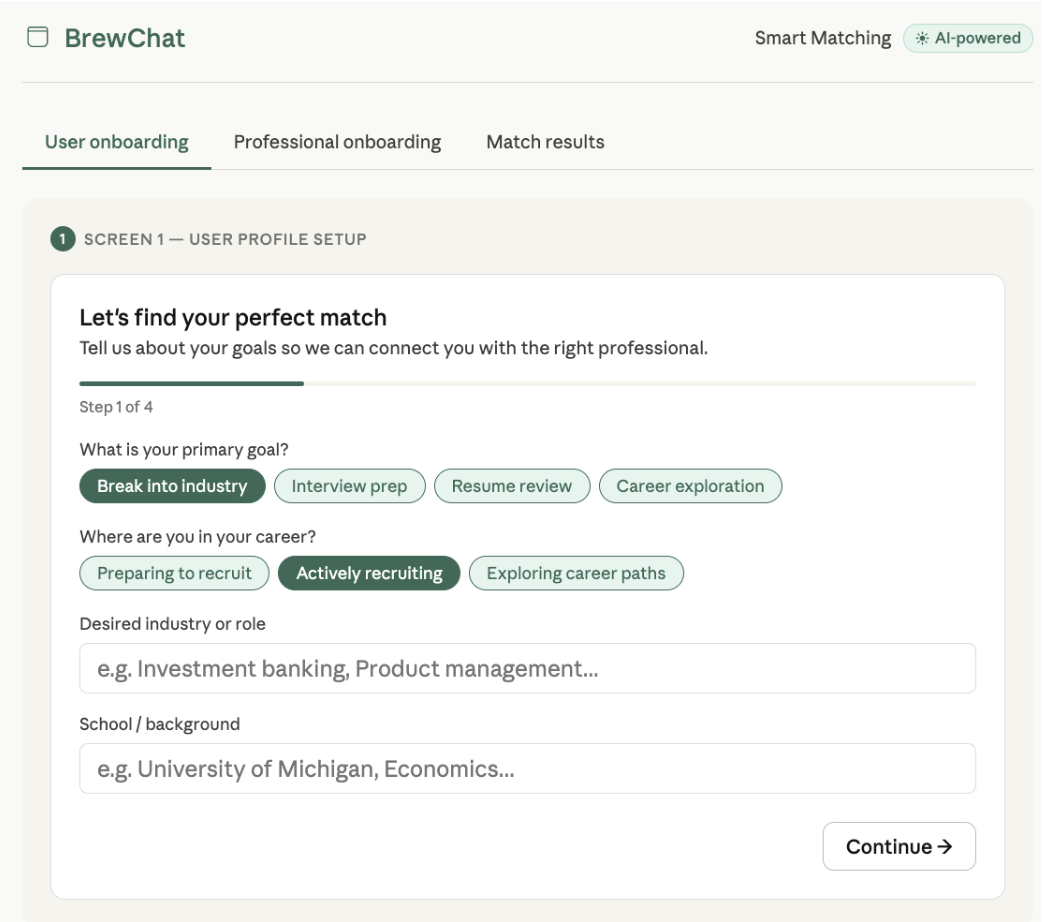
Smart Matching + Precision Filters
Introduce goal-based onboarding and AI-assisted matching using factors like:
Industry · Career Stage · Role · School · Networking Goal
-
Make reliability visible.
What we learned
Users were already looking for signs that professionals were credible and likely to engage — including shared schools, recognizable companies, completed BrewChats, and even profile-photo quality.
Our Recommendation
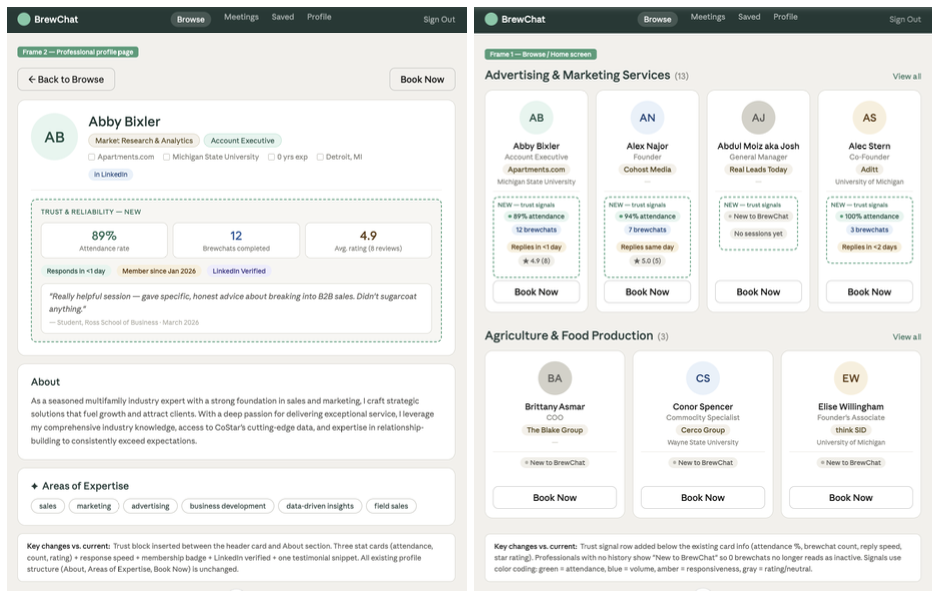
Trust + Activity Signals
Examples:
95% Attendance
12 BrewChats
< 1 day Response Time
-
Don't let the relationship end with the call.
What we learned
BrewChat successfully supported discovery and booking, but the experience ended after the conversation. Users were left to manage thank-you notes, LinkedIn connections, contact saving, and next steps themselves.
Our Recommendation
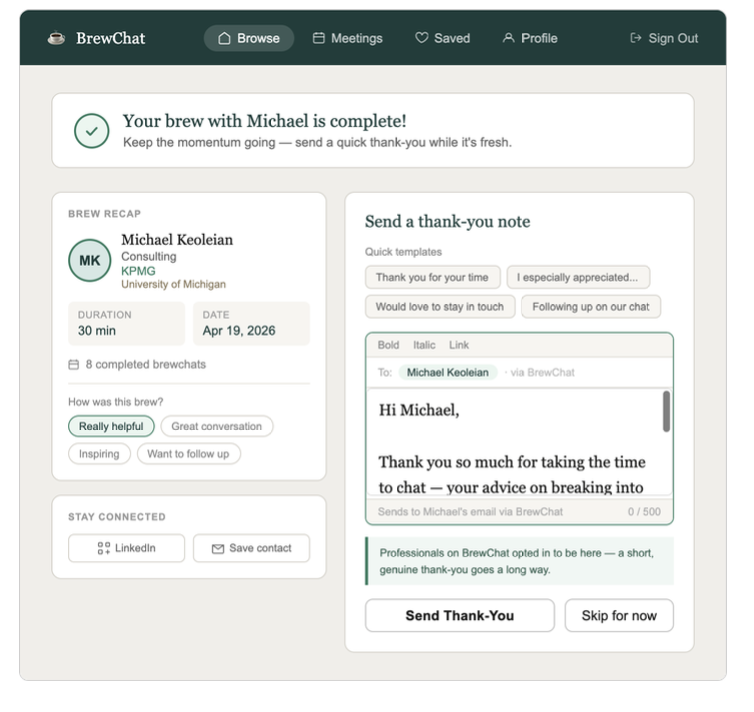
Post-Brew Follow-Up
Send a thank-you
Quick templates make following up easier.React to the conversation
Capture lightweight feedback.Stay connected
Connect on LinkedIn or save contact information.Build the relationship
Turn one conversation into an ongoing professional connection.
Final Solution + Impact
Together, our recommendations extended BrewChat beyond simply facilitating coffee chats. We designed a more intentional experience that helps users find relevant professionals, feel confident booking them, and turn individual conversations into lasting relationships.
-
BrewChat should introduce a goal-aligned onboarding questionnaire for both students and professionals, collecting information on career stage, desired industry, and the type of advice they can offer or are looking for. An AI-powered matching system would then rank professionals by relevance to each student's stated goals, replacing the current keyword search and scroll experience with a curated, intentional discovery flow. Filters by industry, role, career stage, and school background would give users the precision they repeatedly asked for.
Qualitative: from behavioral interviews
Students ("What would make networking with professionals easier?"):
"If there is a list of people in different industry or companies getting list put instead of searching them up one by one."
"An easier way to filter out different jobs/levels"
"An easier network with very specific filters for specific fields"
Professionals ("What would make it easier to connect for quick advice or networking?"):
"Pool of professionals arranged by industry, background, experience and expertise."
Quantitative Surveys: from student & professional surveys
33% of student respondents report difficulty finding relevant professionals
76.2% say an easier way to find relevant professionals would be valuable
57.1% want the ability to filter by industry, company, or role
41.2% of professionals report difficulty finding relevant people (most selected frustration)
64.7% say filters would improve networking platforms (most selected feature)
-
Every browse card should surface three key signals before a student even clicks into a profile: attendance rate, number of completed brewchats, and response time. On the full profile page, star ratings, a short testimonial snippet from a past student, and structured topic tags would give users the confidence to book, and give BrewChat's opted-in model the visibility it deserves. Professionals with no history yet should read as "New to BrewChat," not as an empty or inactive profile.
Across 10 interviews, trust in a professional was the second most cited factor shaping networking behavior, right behind the response problem itself. Key patterns:
"Some people feel like they are not that interested in helping others that they don't know. She is drawn to people who feel personally motivated to give good advice." — Senior participant
"When professionals open the floor for questions and are willing to answer any question with true experiences from their work." — Freshman participant — describing what value looks like
"I would use the platform again if guaranteed bookings and meetings are set up. Indication of a professional's attendance rate is helpful." — Sophomore participant
-
BrewChat should add a dedicated follow-up screen that triggers automatically when a booking moves to completed. The screen would include a brew recap card, a thank-you message composer with quick-fill templates that sends directly to the professional's email, one-tap reaction chips for light feedback, and shortcuts to connect on LinkedIn or save contact information, all without leaving the app. A skip option keeps it low-pressure. This single screen closes the gap between a great conversation and a lasting connection.
Qualitative: from behavioral interviews
“Hard part: finding relevant information to actually utilize from the conversation.”
“Hard to connect the conversation to actionable career steps.”
“Simple and efficient way to connect with professionals who are already willing to help. The mutual opt-in means professionals genuinely want to be there.”
Quantitative Surveys: from student & professional surveys
Networking is inconsistent
43% of students network rarely
Only 24% network frequently
76% of students find networking conversations only “somewhat helpful”
High intent but no structured continuation
81% are very interested in a platform like BrewChat
9/9 users would reuse BrewChat, driven by the mutual opt-in advantage
Gap: High interest + strong first interaction, but no system to convert conversations into outcomes (referrals, relationships, retention)
What I Learned
Smart Matching
FIND
Reliability Signals
TRUST
Seamless Booking
CONNECT
Relationship Building
FOLLOW UP
This project strengthened my ability to turn messy qualitative and quantitative research into clear product decisions. I gained experience conducting behavioral interviews, observing users through live workflows, synthesizing patterns across participants, and working collaboratively to translate research findings into actionable UX recommendations.
Skills Developed: User Interviews Usability Testing Research Synthesis Market Research Product Strategy Team Collaboration